
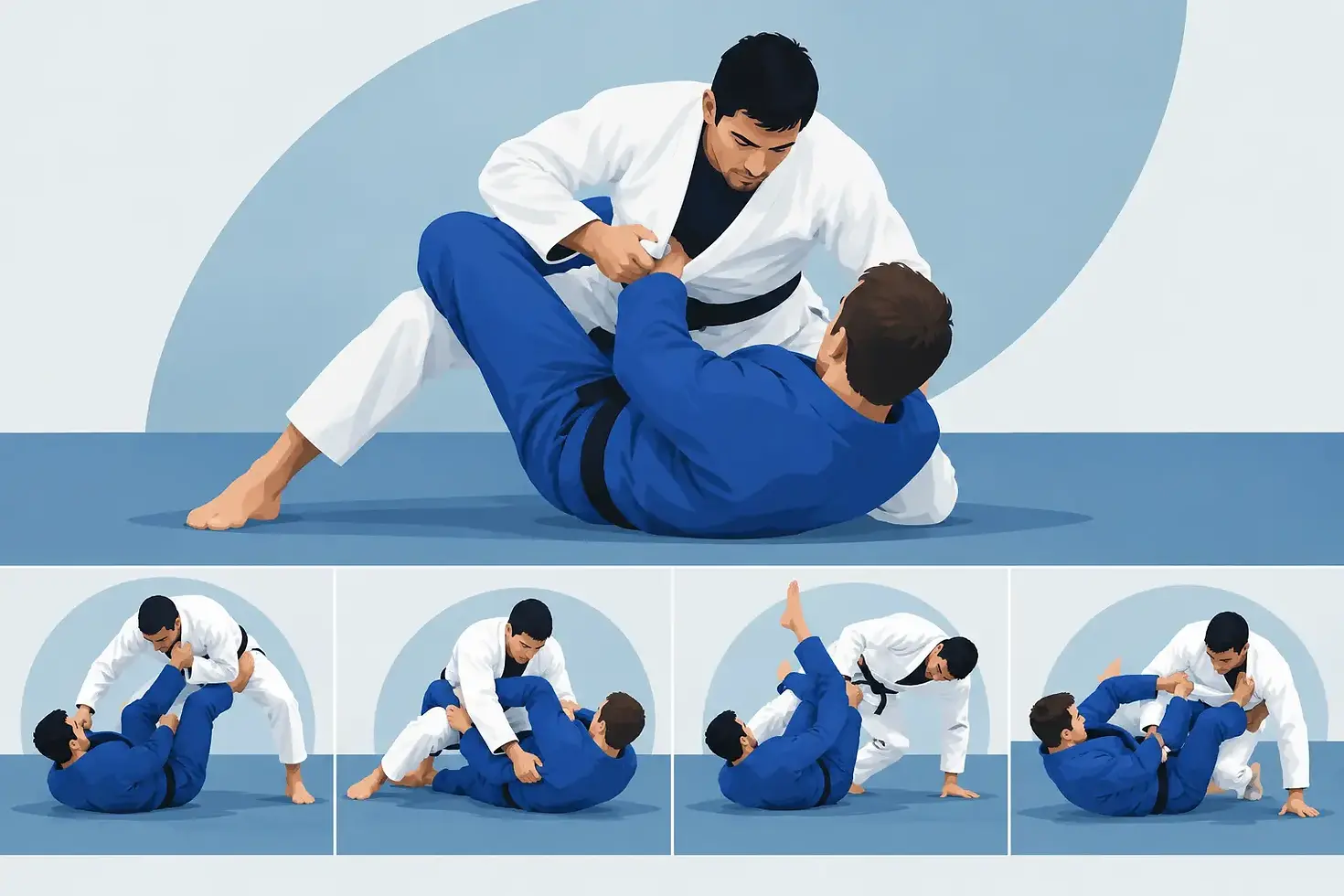
8 Best BJJ Sweeps That Work Under Pressure

A sweep is not a move you collect for belt promotions. It is the moment you take a bad position, break your opponent’s base, and put yourself on top with control. The best BJJ sweeps are the ones you can recognize, enter, and finish against someone who is resisting - not just someone holding still for a demonstration.
For beginners, sweeps create a path out from underneath. For competitors, they create scoring opportunities and force reactions that open submissions and back takes. The common thread is not flexibility or athleticism. It is timing, connection, and understanding where your opponent’s weight is going.
What Makes a BJJ Sweep Work?
A sweep works when you remove one or more posts while directing your opponent’s weight beyond their base. Their hands, knees, feet, and hips are all potential posts. If those posts are planted and their posture is strong, forcing a sweep is usually a losing battle.
The biggest mistake is trying to launch someone with your legs while they are balanced. Instead, first make them react. Pull them forward, off to a side, or backward. Control an arm, sleeve, collar, wrist, or upper body so they cannot simply post. Then use your hips and legs to finish the reversal.
Think of sweeps as chains rather than isolated techniques. A failed scissor sweep may create the posting hand you need for an arm drag. A defended butterfly sweep can expose a leg for a single-leg X entry. Good jiu-jitsu is rarely one clean answer. It is pressure, reactions, and the next attack.
8 Best BJJ Sweeps to Build Into Your Game
1. Scissor Sweep From Closed Guard
The scissor sweep is one of the first techniques many students learn because it teaches essential guard concepts: breaking posture, controlling an arm, creating an angle, and using your shin as a frame. Start with a collar-and-sleeve style connection or a strong upper-body grip that keeps your opponent from sitting tall.
Open your guard only after their posture is compromised. Put one shin across their stomach or belt line, keep your other knee tight, and turn onto your side. Pull them toward the controlled side as you chop with the top shin and drive the lower leg through. Do not kick wildly. The power comes from your angle and their compromised base.
This sweep is less reliable when an experienced opponent keeps a low, wide base. That is not a reason to abandon it. Use their defensive posture to transition into hip-bump attacks, pendulum sweeps, or submissions.
2. Hip-Bump Sweep From Closed Guard
The hip-bump sweep is direct, practical, and useful for self-defense-minded students because it rewards controlling posture and getting your hips underneath the opponent. It also pairs naturally with the kimura. When someone posts their hands or sits upright inside your closed guard, they have given you a window.
Sit up explosively while controlling an arm or wrapping over their shoulder. Post one hand behind you, drive your hips toward the trapped side, and turn them over their blocked arm. Your head and chest should stay close to them. If you lean away, they can base out and shut down the sweep.
If they post the free hand to stop you, attack the kimura. If they pull their arm back, sit up again and re-enter the sweep. That connection is what turns a basic movement into a dependable sequence.
3. Pendulum Sweep From Closed Guard
The pendulum sweep, sometimes called the flower sweep, is powerful because it combines upper-body control with a large leg swing that moves the opponent’s center of gravity. It is particularly effective when your opponent begins to pressure forward and gives you an arm.
Control one arm tightly across your center line while using the other hand to control their sleeve, wrist, or upper body. Open your guard, angle your hips, and swing one leg wide like a pendulum as you pull them forward and across. The leg swing creates momentum, but your grips and angle make the sweep possible.
Keep your opponent’s captured arm from posting. If they can put that hand on the mat, the sweep loses much of its force. This is a strong option for students who prefer a more dynamic closed-guard game, but it still demands clean timing over raw speed.
4. Butterfly Sweep
The butterfly sweep is one of the best BJJ sweeps because it works from a position that appears constantly in live training. Butterfly guard lets you manage distance against a kneeling opponent, elevate their hips, and attack both directions.
Get chest-to-chest connection with an underhook, overhook, or body lock variation. Your head should be close, your elbows tight, and your feet hooked inside their thighs. Fall to the sweeping side while lifting with the hook on that side and steering their upper body in the same direction.
A common error is falling flat on your back and trying to bench-press the opponent overhead. Stay on your side and elevate at an angle. If they widen their base or post to stop the sweep, use that reaction to enter an arm drag, snap them forward, or switch to a single-leg attack.
5. Knee Shield Half Guard Underhook Sweep
Half guard is where many students get stuck because they accept bottom position without a plan. A knee shield and underhook give you a plan. They create space, protect you from pressure, and let you come up to your side instead of remaining flat.
From knee shield half guard, win the underhook and get to your side. Use your shield to manage distance while you work toward your opponent’s leg. As you come up, drive forward and turn the corner like a wrestling finish. The goal is not to roll underneath them. The goal is to build to your elbow, your hand, and eventually your knees while keeping the underhook.
This sweep is especially valuable for MMA and self-defense because it emphasizes getting off your back while controlling the upper body. If your opponent crossfaces hard and flattens you out, recover your frames first. Trying to sweep without posture and an underhook is a low-percentage gamble.
6. Old School Half Guard Sweep
The old school sweep is a dependable answer when an opponent’s weight shifts forward in half guard. Control their far arm or keep them from posting, reach under to trap their far leg, and pull that leg toward you as you drive them over your trapped-leg side.
The detail that matters most is taking away the far leg. If it remains free, they can step out and keep balance. Keep your knees connected around their leg, get under their center of gravity, and come up immediately after the reversal.
It is not flashy, but it teaches a serious lesson: pressure forward creates vulnerability behind the opponent. Students who learn to feel that weight shift find this sweep far more often than students who wait for a perfect setup.
7. Tripod Sweep From Open Guard
The tripod sweep is a fundamental open-guard attack that uses distance management and a simple off-balancing action. Control a sleeve, wrist, or collar, place one foot on the hip, and put your other foot behind or near the opponent’s ankle. Pull their upper body forward while extending the foot on the hip and removing the ankle post.
The opponent falls because their upper body is pulled forward while their leg is taken away. Your timing matters. If they are leaning back, the sweep will feel weak. First create the forward reaction, then attack the ankle.
This sweep is an excellent tool for newer students because it teaches them not to panic when closed guard opens. It also leads into technical stand-ups, single-leg entries, and follow-up sweeps when the opponent steps wide.
8. Single-Leg X Sweep
Single-leg X guard gives you strong control over one leg and creates sweeping options against standing opponents. Once you are underneath their center with your legs configured around one leg, you can lift, tilt, and direct them while limiting their ability to step away.
One reliable finish is to control the far ankle or upper body, extend your legs to off-balance them, and come up as they post or hop. Another option is to tilt them backward before following their leg to the top. The exact finish depends on how they respond, their stance, and whether they are trying to disengage.
Because this position places you close to the legs, train it responsibly. Know your academy’s rules, control your partner’s fall, and prioritize the sweep before any leg-lock exchange. Position first. Control first. Then attack.
How to Choose the Right Sweep in Live Rounds
Do not try to memorize every sweep at once. Build a small system around the guard positions you reach most often. From closed guard, pair the scissor sweep with the hip-bump and pendulum sweep. From butterfly, connect the basic elevation sweep to arm drags and single-leg entries. From half guard, make the underhook your non-negotiable starting point.
During sparring, pay attention to direction. When your opponent drives forward, look for pendulum, old school, and butterfly-style elevation. When they sit back or stand, tripod and single-leg X options become more available. When they post a hand, an arm may be trapped. When they step wide, their weight may be too far from the other leg.
At Parabellum Jiu Jitsu MMA Academy, students train these ideas with progressive resistance, not empty repetitions. The goal is to build timing that holds up when your partner knows what you want and tries to stop it.
Your next breakthrough may not come from learning ten more techniques. It may come from drilling one sweep until you can feel the exact instant an opponent becomes light. Train for that moment, stay composed underneath pressure, and make every reversal count.


Comments